Global Building Supply Wholesale: A Comprehensive Overview for New Players
Building supply wholesale is global now. This should not come as a surprise to anybody involved in this industry for the last 10 years. Global used to rhyme with modernity, free trade, and many advantages for both buying and selling countries. Today’s reality is not as simple, or positive. The supply chains for construction materials are now intricate, interconnected and operationally complex. But the most important thing to understand sits elsewhere. In construction supply, the physical movement of product, the stream of payments, and digitized flux of information (product data, approvals, technical responsibility, etc…) usually don’t follow the same path. On larger or more regulated orders for building materials from China for example, that trend amplifies. It becomes the core condition upon which lays the feasibility of the import project.
That is one reason the construction material procurement still resists the tidy supply-chain diagrams that work better in other industries. The World Bank describes the sector as short-term, project-based, and structurally fragmented. A recent UK construction products supply-chain study reaches a similar conclusion from a different angle: the route taken by the product can diverge from the one taken by ownership, payment, and responsibility within the same project.
For contractors and distributors, that split has practical consequences. It changes who carries stock, who extends credit, who manages substitutions, who absorbs delay, and who is exposed when a product arrives on site but the supporting documentation lags behind.
Through this article, we aim to propose a definition to building supply wholesale, describe its mechanisms, list the players. We will also shed some light on which parameters new players need to consider when setting up building material supplies chains, the stakes and the pitfalls.
PART 1: THE WORKINGS OF THE BUILDING SUPPLIES PURCHASING NETWORKS
Misconceptions About Construction Material Supply and Its Networks
What is Global Supply?
In construction materials, “global” is not a synonym for distant sourcing. It is a description of how local extraction, regional processing, domestic distribution, imported finished goods, and project-specific procurement can intersect inside one commercial field. A cement market can remain overwhelmingly regional in its physical footprint and still be affected by imports, freight bottlenecks, corporate consolidation, and shifts in upstream energy or mineral inputs. The same is true, in a different way, for insulation, siding, fittings, cable, or envelope systems that are easier to move across borders.
Global supply for wholesale building materials is the international and cross-regional sourcing, production, transport, and distribution network through which building materials move from manufacturers and processors to importers, distributors, and B2B buyers. It covers the full commercial flow of products across countries and markets, not just overseas purchasing.
That distinction is useful because it keeps the term “global” tied to route design rather than geography alone. In essence, building supply is not global simply because shipping containers exist. It becomes global when supply, ownership, and specification begin to draw on more than one production, distribution base, and information networks. Now if construction materials supply is global in form, what are its physical and dematerialized limits?
Are There Any Frontiers to the Global Building Supplies Market?
Yes, there are and they are stubborn. Construction materials do not all respond to the same economic rules and don’t move the same way.
For example, heavy mineral products remain far more exposed to freight cost, handling cost, and distance than lighter finished goods or more differentiated systems. UK government materials research makes the point plainly: many core construction materials are bulky, heavy, and low in value relative to their mass. It is one reason that explains local sourcing remains structurally important in large parts of the sector.
“The distinctness of these processes, as well as the fixed-term, project-based nature of relationships along the supply chain, results in a highly fragmented industry structure.“
From the Construction Industry Value Chain published by IFC of World Bank Group.
The U.S. side tells much the same story. USGS data for 2024 put U.S. construction sand and gravel output at an estimated 890 million tons. From which a large share goes into concrete aggregate. Those are not flows that invite casual long-distance building raw material shipping. Even cement, which moves more broadly than aggregates, still shows the tension between domestic production and selective import reliance. Obviously, the building supply is not a borderless market in any simple sense.
Those frontiers are merely physical and economical limits, they do not mean the end of global trade. Instead, they push industry players to categorize materials & supplies into global imports and local imports. We can thus conclude that broad discussions about how construction materials supply works quickly become skewed or inaccurate.
A Surprising Non-Linear Supply Chain for Building Supplies
It is more accurate to treat it as project supply structure than a neat linear supply chain. The World Bank’s construction value-chain work emphasizes the sector’s short-term contracting patterns and one-off project relationships, both of which limit the kind of stable vertical integration seen elsewhere. A UK government study on construction supply chains found at least three tiers involved in the delivery of complex subcontract packages, with procurement, logistics, and on-site coordination spread across different firms.
That point matters less as theory than as a reading tool. A batch of imported cladding , shipping containers loaded with insulation material from Turkey, or a drywall order from China can be physically similar from one project to the next. However they each involve different intermediaries, different payment arrangements, and different technical approval routes depending on the project size, contract structure, and risk profile. The product may be easy to define, its complexity lies in its supply chain.
The complexity of building supply wholesale does not mainly come from the products themselves, but from the supply chain that moves them across manufacturers, importers, distributors, and jobsites. Once that is clear, the real question is no longer where products come from, but how complex this supply chain becomes as materials, actors, and responsibilities multiply.
One Building Supplies Wholesale Market, 3 Core Routes
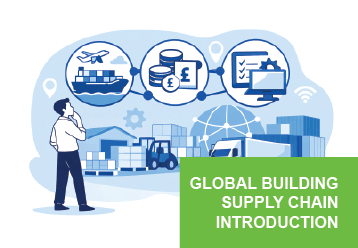
In practice, this supply chain breaks down into three distinct routes: shipping, finance, and digital information. Each route follows its own logic, involves its own actors, and creates its own constraints. Taken together, they show why the supply of wholesale building materials cannot be reduced to the physical movement of products alone.
The Goods: Physical Supply Routes
This is the most visible part of the supply chain. Materials move from extraction or industrial processing into manufacturing, then into importer stock, distributor inventory, merchant yards, specialist channels, or directly to a project. The exact route varies by product category, but the main point stays the same: physical constraints shape supply options from the start. A bagged product, a framed component, a board product, and an aggregate flow do not move through the supply chain in the same way.
That is why the physical route can look efficient and still say little about where commercial control actually sits. Product movement is the most visible part of the supply chain, but not always the part that determines how the transaction works.
The next route says more about control, risk, and negotiating power.
The Dollars: Money Circulation Pathways
The party moving the goods is not always the party waiting to be paid. The party paying for the goods is not always the party installing them. The UK construction products supply-chain report is useful here because it distinguishes the path taken by the product from the path taken by ownership and payment. That split becomes more visible as projects grow in size, face tighter regulation, or rely more heavily on specialist subcontracting.
This is where much of the commercial friction in the supply chain sits. Credit terms, account control, staged billing, title transfer, warranty linkage, and working-capital exposure all sit within the money route. A buyer who only looks at factory price and delivered cost is often missing the part of the transaction that matters most commercially.
There is still a third route, and it is often the one that gets overlooked until something goes wrong.
And the Bits, Digitized Information Highways
Information in construction supply is not just paperwork. It affects whether a product can be approved, installed, and supported correctly. Specifications, declarations, approvals, substitutions, installation instructions, warranty conditions, and compliance documents often move on a different timeline from the goods or the invoices. The UK construction products study is clear on this point: even when ownership and physical delivery follow different paths, the installer still needs the right information for the product to be used properly. World Bank procurement guidance reaches a similar conclusion, treating supply-chain mapping, vulnerability checks, and ongoing monitoring as practical requirements rather than optional good practice.
This route becomes more important as products become more technical, more regulated, or more dependent on system compatibility. It also becomes more fragile when a project relies on several intermediaries, last-minute substitutions, or imported supply that arrives before the supporting documentation is fully in place.
Once these three routes are separated, the supply chain becomes easier to understand. The next step is to see how those routes change depending on construction materials.
The Making of Wholesale Building Supply
Before building materials enter importer stock, distributor inventory, or merchant yards, they pass through a longer industrial chain that begins well upstream of the buyer. Raw material extraction, processing, refining, and product manufacturing all shape how a supply chain is built around each category. This matters because supply conditions are often set long before a finished product reaches the wholesale level.
The Origin: Raw Materials Are the Starting Point of Any Building Supplies
No construction supply network begins at the warehouse gate. It begins with extraction, refining, and industrial transformation. Cement starts with mineral inputs and clinker production. Gypsum products begin with gypsum feedstock. Aggregates depend on quarry networks. Timber and panel products depend on forestry and processing chains that follow a different set of cost and regulatory pressures. The World Bank’s construction value-chain work places raw materials at the base of the sector for a reason.
That upstream base also explains why certain supply shocks arrive late. By the time a distributor sees pressure in availability or lead time, the constraint often sits two or three stages further back.
The Transformation: Processing and Refining Into Half-Finished Construction Materials
Between extraction and finished product sits a wide industrial middle. That stage is easy to overlook because buyers rarely purchase it directly, yet it shapes price, availability, and the degree of substitution that is possible further downstream. It is also the point where local and imported content often begin to mix in ways that are not obvious from the finished product label alone.
Clinker, lime, panels, mineral wool inputs, resin-based compounds, treated timber, and semi-finished metals are not yet in their finished form. They are merely unfinished building materials, or construction supply components (i.e: kraft or aluminum wrap may need to be laminated with mineral wool before it becomes a finished insulation mat). Construction supply often becomes hard to read here because many buyers only see the finished product and not the industrial chain behind it.
This is one reason simplistic origin stories do not help much in building materials. A product may be assembled domestically while depending on imported inputs, or imported as a finished line while still relying on domestic stocking and technical support to be commercially useful.
That industrial middle is where product class starts to matter more sharply.
The Gathering: When All Parts of Building Supplies Come Together
Many building products are assemblies. A window system, a siding system, a drywall package, or an insulated envelope product often combines several materials, subcomponents, and compliance documents before it reaches the channel. That is why construction supply is rarely just “material supply.” It is product assembly plus documentation plus route management.
This is where imported and domestic inputs start to mix. It also explains why technical information travels beside the goods.
The Making: Manufacturing of Finished Construction Materials
At this stage, building materials stop being industrial inputs and become finished products. Fiber cement panels are cast and cured. Plywood is laminated and pressed. Floor tiles are printed, glazed, and lacquered. Siding and insulation products are cut, finished, and packed to standard specifications. By the time these products enter wholesale channels, their form, handling needs, and shipping profile are already set in large part by the manufacturing process.
At the finished stage, categories become clearer. The NAICS manual separates construction material wholesaling into wood panels and millwork, brick and stone related materials, roofing and siding and insulation materials, and other construction materials. That classification is useful because it mirrors how the market itself segments product families.
Once products become finished goods, their physical parameter starts weighing into what their supply chain is shaped.
Materials Weight Do Matter, Physical Limits to Building Supply Movements
Heavy, Low Value-to-Weight Materials
Heavy mineral products do not merely cost more to move. They often force a different commercial structure. Distance reduces flexibility, raises exposure to transport volatility, and makes local stocking strategy more important. The U.S. geological data and the UK materials research both support the same broad conclusion: categories such as aggregates, cement, and other dense mineral products still obey geography more closely than many buyers assume when they speak loosely about “global sourcing.”
This is the first major split in the supply chain. Not all building products can support the same sourcing radius, stocking model, or distribution path.
Lighter, More Tradable Manufactured Products
Lighter manufactured products follow a different supply chain logic. Higher-value lines can absorb more transport, more warehousing, and more distribution layers before freight begins to erode their commercial viability.
That makes them better suited to broader import programs, regional stockholding, and multi-tier distribution. In these categories, the supply chain becomes less constrained by plant proximity and more shaped by channel structure, stock policy, and order flow.
This difference carries directly into how the distribution side of the supply chain is built. That is where the next section begins.
PART 2: The Key Distribution Players in Building Supply Wholesale
Building Supply Manufacturing Companies
Manufacturers create the product, but they do not control every step between production and the jobsite. Some sell directly to large accounts. Many work through importers, master distributors, regional distributors, merchants, or specialists.
That is an important distinction. Manufacturing sits at the center of the supply chain, but the route from production to delivery is often shared with several downstream actors.
Those downstream actors start with the companies that convert factory output into locally usable supply.
Wholesale Building Supply Importers
Importers turn offshore or cross-border production into stock that local buyers can actually purchase. They handle freight coordination, customs formalities, landed cost, packaging adjustments, and sometimes product adaptation or document control.
In many product categories, importers are the first domestic supplier to make overseas production commercially usable. They often carry the burden of converting factory output into something distributors, merchants, or contractors can buy under workable terms.
That makes them more than logistics intermediaries. From there, the chain moves into the broader distribution tiers.
Construction Materials Distributors
Distributors sit at a critical point in the supply chain. They hold stock, manage account terms, coordinate deliveries, and connect factory or importer supply to repeat local demand.
Their value is practical. They absorb stock risk, break bulk for smaller buyers, manage local service, and shorten the distance between industrial supply and project needs. In many categories, they are the reason a product becomes reliably available rather than theoretically available.
The Master Distributor, One to Govern Them All
A master distributor usually operates at broader scale. It aggregates brands, covers a wider territory, and supplies lower distribution tiers rather than only end buyers. This model works best where demand is spread across regions and product lines are standardized enough to move through a common network.
Its strength lies in reach, purchasing power, and stock concentration. It can support large flows and broad assortment. Its weakness is distance from the day-to-day realities of smaller local accounts.
The Regional Distributor
Regional distributors sit closer to demand. They are more exposed to local project timing, contractor relationships, delivery density, and local stock priorities.
This position allows them to respond faster and tailor their stock to what actually moves in a defined territory. They often know better than anyone which product lines are reordered regularly and which are only asked for occasionally.
That local closeness also creates room for another model. In more technical product families, specialization can matter even more than territory.
The Specialist Product Distributor
Specialist distributors focus on narrower categories such as drywall, insulation, siding, or roofing-related lines. They compete through depth, technical understanding, product compatibility, and closer trade relationships.
This makes them especially relevant where substitutions are risky, documentation matters, or installers work with system-based products rather than simple commodity items. Their value often comes from category control rather than from carrying the widest possible assortment.
That specialized model sits alongside a broader mixed-basket model. That is where merchants and wholesalers enter the picture.
Builder’s Merchants and Wholesalers
Merchants and wholesalers usually sit closer to recurring trade demand, mixed baskets, and moderate order sizes. They are especially important for buyers who need flexibility, regular replenishment, and a practical combination of stock availability and account convenience.
This role reflects how the supply chain works in practice better than a simple retail-versus-wholesale split. Many professional buyers do not fit neatly into one or the other. They buy repeatedly, but not always at project-scale volumes.
That mixed-basket role helps explain why different contractor profiles end up using different supply routes. The final commercial layer before installation makes that even clearer.
Contractors, Building Companies, and Retailers
The final commercial buyer is not always the same kind of actor. Some contractors buy directly. Some building companies centralize purchasing. Some retailers overlap with pro supply and serve trade buyers through account-based channels.
That is why it helps to separate contractor-buyers, centralized building companies, and pro-focused retail buyers when looking at how materials move through the supply chain. Lumping them together hides too many differences.
Those differences become much more visible once procurement is examined from the buyer’s side. That is the focus of Part 3.
PART 3: Practical Information on Wholesale Construction Materials Procurement for Buyers
What Wholesalers and Distributors Actually Do
Many buyers still treat wholesalers and distributors as simple resale steps added on top of factory pricing. That view misses the operational work they perform inside the supply chain.
Their role is easier to understand once each function is separated clearly. The first one is stockholding.
Not Just Building Supplies Import, but Inventory Buffering
Wholesalers and distributors do not only resell product. They hold stock before the project needs it. That means they tie up capital so that other buyers do not have to.
This stock function reduces supply interruption, shortens lead times, and supports repeat buying. It also allows smaller and medium-sized buyers to access product in workable quantities without waiting for factory cycles or import consolidation.
That buffering role leads directly to the next one. Stock becomes much more useful when demand is pooled.
How Wholesalers Turn Scattered Orders Into Reliable Volume
Wholesalers and distributors aggregate demand. Small and medium orders from multiple jobsites become one clearer replenishment signal upstream.
This matters because scattered orders alone do not always justify factory attention, import consolidation, or deep stockholding. Aggregation turns fragmented demand into usable order volume for replenishment, stocking, and scheduled delivery.
That pooled demand also supports something many buyers depend on every day. It supports trade credit and account management.
Cashflow, Credit and Builders Account Management
Credit is one of the most important functions in the supply chain. Payment timing often matters just as much as unit price, especially for contractors and smaller building firms.
Distributors and wholesalers frequently extend account terms, stage invoicing, and manage payment cycles in ways that help jobs keep moving. This is one reason the finance route matters so much. Supply often depends on who can carry the receivable, not only on who can move the pallet.
That financial support is only one side of the service model. The next side is technical.
Construction Materials Technical Support
Technical support is not a decorative extra. It affects whether a product is selected correctly, approved correctly, and installed correctly.
This includes specification checks, compatibility guidance, installation information, product document handling, and support around substitutes. In more technical categories, this function becomes central to the supply chain because mistakes tend to surface late and expensively.
That support role becomes even more valuable when delivery conditions are tight. This leads directly to local coordination.
Local Delivery Coordination
A nearby supplier is often useful for one reason above all others: it can deliver in the right sequence. Construction supply is not only about getting materials to the right place. It is about getting them there at the right moment and in the right order.
Local coordination matters because many projects cannot receive everything at once. Storage is limited, access is constrained, and trades need materials staged around site progress. This is where distribution turns into real operational support.
Once these functions are clear, the main procurement routes become easier to compare. That is where the next section goes.
Construction Materials Procurement and Supply Chain Types
Factory Direct Wholesale Building Supply
Buying building supplies factory-direct works best when volume is high, specifications are stable, and the buyer has enough planning capacity to manage the route. It suits larger buyers better than smaller ones because the commercial and logistical burden is heavier.
A direct route can reduce one distribution layer, but it can also increase exposure to MOQ pressure, lead-time rigidity, freight complexity, and document handling. It is often efficient only when the buyer can carry the operational load that comes with it.
That is why direct supply is not the default route for most professional buyers. The distributor route remains more practical in many cases.
Buying From Building Supplies Distributors
Distributor purchasing is often the most balanced route for professional buyers. It combines access to stock, account management, local delivery, and technical support without requiring the buyer to run the entire upstream chain directly.
This route is especially useful when projects need repeat reliability rather than one-off bulk movement. It works well for buyers who want operational flexibility without losing commercial structure.
That still leaves another common route. It sits between retail simplicity and large-project procurement.
Wholesaler and Merchant Purchasing
Merchant and wholesaler purchasing fits recurring trade demand, mixed baskets, and moderate order sizes. It is less about maximizing one line item and more about keeping daily work moving across several ongoing jobs.
This route often suits smaller builders, one-unit contractors, and firms that buy repeatedly but not in large planned packages. Convenience, stock access, workable minimums, and account terms often matter more here than factory-direct optimization.
That difference becomes even clearer once order scale enters the picture. Project size changes the logic of procurement.
To Each Building Project Size, Its Own Supplies Purchasing Strategy
Large Wholesale Building Materials Orders
Large orders do not simply mean more volume. They create a different purchasing environment.
At this scale, the buyer can often negotiate on price, reserve capacity, ask for stronger service commitments, and demand more formal support. At the same time, the cost of mistakes becomes much higher, so routing decisions become more important.
That larger purchasing context can be broken down into several practical features. The first is leverage.
Leverage Volumes
Larger volumes give buyers more negotiating power. They can influence price, lead times, production allocation, stock reservation, and service levels more than smaller accounts can.
This does not guarantee the best route. It does mean more options open up. The buyer can consider direct factory supply, stronger distributor terms, or hybrid sourcing structures that smaller accounts could not easily access.
Once leverage increases, delivery becomes the next major concern. Bigger orders rarely move in one simple batch.
Scaled Delivery
Large projects usually require staged delivery. Materials need to arrive in sequence, not just in full. Too much product too early creates storage and handling problems. Too little product too late creates delay.
That means delivery planning becomes part of the supply chain design itself. Suppliers who can stage, hold, split, and schedule product often become more valuable than suppliers who only look competitive on unit price.
That delivery pressure then moves directly into the financial side of the relationship. Payment structure becomes harder to ignore.
The Payment Terms War
Large orders tie up real money. Payment terms therefore become a decisive part of the commercial negotiation.
Deposit requirements, billing stages, credit length, title transfer, and exposure during transit or storage all matter more at scale. Financial capacity starts to matter as much as stock availability and delivery performance.
Once financial exposure rises, compliance and document discipline also come under greater pressure. That is where formal sourcing requirements become harder to avoid.
Compliance and Responsible Wholesale Building Supply Sourcing
Larger projects usually require more documentation, more approval discipline, and more traceability. Product fit, certification, substitution handling, and recordkeeping all become more important as project size and liability increase.
This changes the supply route. Buyers may favor suppliers that can support documentation and control rather than suppliers that only offer a lower headline price. The route becomes more formal because the project itself becomes less tolerant of ambiguity. In many instances, buyers secure the services of local inspection companies to inspect building supplies compliance with local standards in order to minimize risks.
That is the large-order side of the picture. Between that and small-buyer purchasing sits a middle tier that is often overlooked.
Semi-Wholesale Purchasing Strategy
This is the zone many real buyers operate in. It is not retail buying, and it is not the same as large-project procurement either.
These buyers purchase repeatedly, often for one dwelling unit at a time, small developments, or several modest jobs running in parallel. Their needs are steady, but their scale remains limited. That creates its own supply chain logic.
A Focus on Base Materials
Semi-wholesale buyers often start by securing their base materials and repeat-use lines. These are easier to forecast, easier to justify in modest bulk, and more likely to serve several jobs at once.
This usually leaves buyers dealing with a smaller supplier pool, where minimum order quantities and break-bulk flexibility matter much more. More variable finishing products may still be purchased in smaller cycles through local channels.
That leads directly to the next issue. In this part of the chain, MOQ flexibility matters a great deal.
Building Supplies MOQ Flexibility
MOQ is not only set at factory level. It also depends on whether importers, distributors, or merchants are willing to break bulk and resell in smaller quantities.
This is one of the practical reasons semi-wholesale buyers often prefer distributors or merchants over factory-direct routes. The channel absorbs the rigidity of upstream supply and converts it into something more workable.
Once MOQ becomes manageable, lead time becomes the next pressure point. This is where repeat buying starts to separate good suppliers from merely available ones.
Fighting for Shorter Delivery Lead Times
Semi-wholesale buyers depend on repeat reliability. They often do not have the balance sheet to hold deep stock, so late deliveries hit quickly.
This often pushes them toward a smaller product range and a shorter list of dependable suppliers rather than the broadest possible catalog. Predictability matters more than variety when several modest jobs are moving at once.
That leads naturally to the smallest professional buyer profile, where sourcing options narrow further.
Small Buyers, Narrower Supply Paths
Small professional buyers are still part of wholesale building supply, but they operate under tighter limits. Order size, cashflow, delivery urgency, and storage capacity all narrow the routes available to them.
The result is not a weaker role in the industry. It is a more constrained supply chain position. That becomes clear in the three issues below.
To Import or Not to Import, That Is the Question
For small buyers, direct import can appear attractive on paper. Lower unit cost, direct factory access, and wider sourcing choice all look appealing.
In practice, direct import often brings too much operational burden for the scale involved. Whether it has to do with freight plan, clearing customs for shipping containers from China, risks associated with packaging, or document control, they each require professionnals to deal with. In addition, minimum order quantities, and construction materials after-sales support all add weight when the order is relatively small.
That is why the question is not whether import is possible. It is whether the buyer’s scale can support the route.
Strapped for Cash for Volume Orders
Small buyers rarely have the cash position needed to place large orders simply to unlock better unit costs. Limited working capital often cuts off access to larger order quantities, longer lead-time planning, and direct upstream relationships.
This is one reason local distributors and merchants remain important even when pricing is transparent. The buyer is not only paying for product. The buyer is paying for access to a workable supply route.
That usually pushes the decision toward the shortest practical route. Local supply becomes harder to replace.
Local Is the Most Direct Route
For many small contractors, local supply remains the most workable answer. It reduces MOQ pressure, shortens delivery cycles, and lowers the consequences of ordering mistakes.
This does not mean local is always cheapest on paper. It means local is often the route that best matches the buyer’s order size, cashflow, and job rhythm. For smaller accounts, that fit often matters more than a theoretical savings from a more distant route.
That closes the buyer-side view of procurement. The next part turns to the logistics forces that shape these routes in the first place.